
 AI Governance
 Data Centers
 Drones
 Climate
 Privacy
 2026 Maine Senate
 Bob Dylan

Drones Move Into Everyday Deliveries
Coverage from Akron Beacon Journal, DroneXL, and others
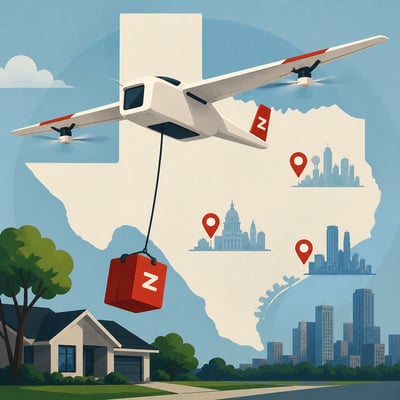
Zipline is expanding autonomous drone delivery from commercial pilots into recurring services for Cleveland Clinic prescriptions, Taco Bueno meals, and Walmart orders in suburban Texas and Ohio.
Cleveland Clinic’s Beachwood program is the most developed healthcare deployment, initially serving eligible patients within five miles and excluding controlled and other restricted medications. The expansion shows delivery drones moving into routine consumer and medical use while operational limits, safety events, and broader BVLOS rules remain relevant constraints.
If you read one thing
It provides the clearest overview of Zipline’s recurring healthcare deployment, including delivery performance, operating limits, and expansion context.
The evidence
It documents the repeatable suburban Texas model and the operational scale underlying Zipline’s broader commercial network expansion.
Latest development
It captures the latest material safety event and explains how an off-nominal recovery bears on deployment and neighborhood-safety requirements.
U.S. commercial delivery network expansion
Zipline is operating a repeatable suburban delivery model across Texas, with restaurant, retail, and consumer services supported by partners including Taco Bueno, Wonder, and Walmart. Expansion is geographically broadening, but some announced deployments remain planned rather than fully operational.
Healthcare logistics moving into routine use
Healthcare drone delivery has moved beyond a prospective pilot at Cleveland Clinic: the Beachwood program conducts recurring prescription deliveries, about 20 per week, with reported availability above 90% during severe weather. Broader health-system networks remain planned, so adoption is established at one site but uneven across the sector.
Deployment scope remains constrained
Current services remain bounded by local coverage areas, eligible home environments, medication restrictions, infrastructure, and regulatory readiness. Cleveland Clinic’s five-mile service excludes several medication categories, while planned BVLOS networks and recent parachute deployments keep recovery, oversight, and neighborhood safety material constraints on scale.
15 minutes
prescription delivery time
“Traditional courier delivery can take hours or days, while a drone may deliver a package within about 15 minutes for patients inside the service radius.”
70 miles per hour
drone flight speed
“The drone travels at about 70 miles per hour and releases the package from approximately an inch and a quarter above the ground. It then retrieves the pod and returns to the charging tower.”
above 90%
service availability
“The service maintained availability above 90% through several weeks of heavy rain and wind, according to Bri Robinson, Cleveland Clinic’s home-delivery pharmacy manager.”
12 drones
capacity supported by charging infrastructure
“The Beachwood campus has four drones, with charging infrastructure that can support expansion to 12, according to Bri Robinson, Cleveland Clinic’s home delivery pharmacy manager.”
20 deliveries weekly
current delivery volume
“Cleveland Clinic launched a prescription drug drone delivery program from its Beachwood, Ohio, campus in late July. The health system says it is the first long-term, established prescription drug drone delivery program in the country. The service currently operates within a five-mile radius of the campus at 3175 Science Park Drive, with about 20 deliveries made weekly.”
Another Zipline flight failure exposes uncontrolled-landing risks
A Zipline aircraft ended a flight on a Houston-area highway after deploying its emergency parachute. Although the system prevented injuries, the unresolved failure and uncontrolled landing location add to the safety and recovery challenges facing expanded delivery operations.
Previously
Zipline is expanding autonomous drone delivery from commercial pilots into recurring services for Cleveland Clinic prescriptions, Taco Bueno meals, and Walmart orders in suburban Texas and Ohio. Cleveland Clinic’s Beachwood program is the most developed healthcare deployment, initially serving eligible patients within five miles and excluding controlled and other restricted medications. The expansion shows delivery drones moving into routine consumer and medical use while operational limits, safety events, and broader BVLOS rules remain relevant constraints.
Zipline’s U.S. expansion is now more concretely implemented through recurring Cleveland Clinic, Taco Bueno, and Walmart services rather than mainly announced pilots. A parachute deployment in Texas adds a new operational-safety dimension, although no injuries were reported.
The story has moved from planned healthcare pilots toward at least one live commercial deployment: Cleveland Clinic and Zipline launched limited prescription delivery in Beachwood. The broader framing also shifts toward recurring U.S. operations, although future BayCare and Wonder deployments remain planned.