
 AI Governance
 Data Centers
 Drones
 Climate
 Privacy
 2026 Maine Senate
 Bob Dylan
Tariffs Test Collins' Independence
Coverage from Knewz, WMTW, and others
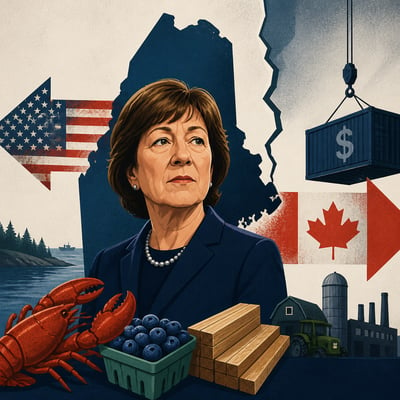
The 2026 Maine Senate contest is using the Trump administration's tariffs on Canada as a test of Susan Collins' independence and economic judgment.
Collins warns that tariffs and possible Canadian retaliation could raise costs or damage Maine's lobster, blueberry, potato, lumber, manufacturing, farming, and border-related businesses, while Troy Jackson argues that she has not challenged President Donald Trump sufficiently. The issue matters because Canada is Maine's largest trading partner, although Canada's removal of seafood from planned tariffs eased the immediate threat to lobster interests.
If you read one thing
This local overview connects Maine's cross-border economic exposure, Collins' tariff strategy, and Jackson's campaign attack.
The evidence
The fact-check adds essential evidence about the competing claims over Collins' tariff voting record.
The evidence
This national account explains how Maine's dependence on Canada turns tariff exposure into a broader electoral vulnerability.
Broad Maine exposure to Canada trade risks
Maine's dependence on Canadian trade keeps tariffs consequential for exporters, manufacturers, agriculture, lobster, consumers, and municipalities. The corpus identifies Canada as the source of roughly 40% of Maine goods exports and nearly 70% of imports, with additional exposure in fuel, road salt, concrete, and other cross-border goods.
Collins is pursuing opposition and targeted relief
Susan Collins is presenting herself as an independent advocate for Maine by criticizing Trump's Canadian tariffs, supporting efforts to halt them, seeking negotiations, and pursuing carveouts for affected products. Her approach remains focused on targeted relief and economic warnings rather than a complete break with the administration.
Tariff accountability is a contested campaign test
Troy Jackson is using tariffs, affordability, and Maine's trade exposure to portray Collins as insufficiently independent from Donald Trump. The attack remains constrained by fact-checking that found Jackson omitted four Collins votes opposing Trump's tariffs, giving Collins a substantive rebuttal while leaving the issue electorally central.
41% percent
Maine exports accounted for by Canada
“Canada is Maine’s biggest trading partner, accounting for 69% of imports and 41% of exports in 2025, according to the U.S. Census Bureau.”
More than 80% percent
Maine heating oil and gasoline imported from Canada
“More than 80% of the state’s heating oil and gasoline is imported from Canada, while wild blueberries, lobsters and lumber depend heavily on cross-border trade.”
about 900 people
Frenchville population
“Frenchville, a northern Maine town of about 900 people, could spend roughly $10,000 more on road salt this winter, she said. Manufacturers relying on concrete could face approximately $150,000 in additional monthly costs.”
four votes
Collins votes opposing Trump's tariffs
“PolitiFact concluded that Jackson cited one 2025 vote against rescinding tariffs if they increased consumer costs and cited Cabinet confirmations involving officials who supported tariffs. However, he omitted Collins' four votes opposing Trump's tariffs.”
nearly 70% percent
Maine imports supplied by Canada
“Maine Public's analysis of trade data found that 40% of Maine's $3.2 billion in exports went to Canada in 2025, while Canada accounted for nearly 70% of the state's imports.”
The new articles reinforce the existing account that Canadian tariffs expose Maine's economic dependence on Canada and provide Collins and Jackson with competing arguments over her independence from Trump, without adding a material new development.
Previously
The 2026 Maine Senate contest is using the Trump administration's tariffs on Canada as a test of Susan Collins' independence and economic judgment. Collins warns that tariffs and possible Canadian retaliation could raise costs or damage Maine's lobster, blueberry, potato, lumber, manufacturing, farming, and border-related businesses, while Troy Jackson argues that she has not challenged President Donald Trump sufficiently. The issue matters because Canada is Maine's largest trading partner, although Canada's removal of seafood from planned tariffs eased the immediate threat to lobster interests.
The current version largely confirms the existing framing, adding a more specific measure of Maine's Canadian trade dependence: roughly 40% of goods exports go to Canada.
The story adds municipal cost exposure and specific tariff-relief efforts, while otherwise confirming that tariffs remain the race’s central economic and political issue.