
 AI Governance
 Data Centers
 Drones
 Climate
 Privacy
 2026 Maine Senate
 Bob Dylan
Jackson Tests Collins’ Crossover Coalition
Coverage from Bangor Daily News, The Maine Monitor, and others
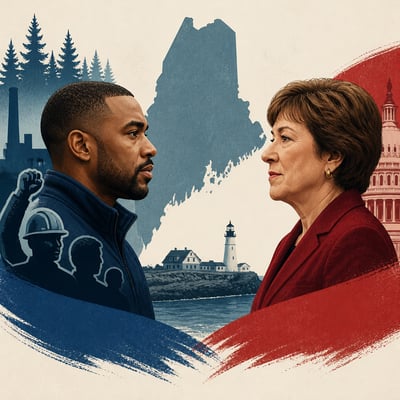
Troy Jackson is challenging five-term Republican Senator Susan Collins after replacing Graham Platner as the Democratic nominee in July.
Jackson has built his campaign around working-class credentials, labor support, healthcare access, and opposition to Donald Trump, while Collins is emphasizing bipartisan credibility, constituent service, federal investment, and her Appropriations Committee role. Polls generally show Jackson with a narrow lead, but the contest remains unsettled because Collins has greater name recognition, stronger financial support, and an established base among crossover voters.
The story is largely stable, but the current version adds specific labor backing from the AFL-CIO and notes that Graham Platner denied sexual-assault allegations when withdrawing.
The update moves beyond a polling-focused contest by adding concrete campaign activity: four scheduled debates, expanding outside-group advertising and canvassing, and a sharper focus on crossover-heavy regions. It also identifies new outside actors and more specific ethics-related attacks.
The race is now framed less as a straightforward competitive matchup and more as a test of whether Jackson has genuine personal support beyond anti-Collins sentiment. Platner's withdrawal is also tied more explicitly to a sexual-assault allegation he denied.
The race is increasingly framed around affordability and Jackson’s ability to build a statewide coalition beyond labor and northern Maine, rather than solely around candidate attacks and polling. Outside groups and campaign attacks have also broadened, while debate timing creates a tighter pre-election schedule.
The race is now framed more explicitly as a toss-up despite Jackson’s narrow polling edge, with Collins’s institutional advantages receiving greater emphasis. The election’s mechanics also gained prominence through scheduled debates and potential ranked-choice tabulation.
The core race dynamics remain stable, but Jackson’s labor backing is now reflected in concrete campaign activity, including a Southern Maine Labor Council event focused on affordability and healthcare.
New polling detail suggests much of Jackson’s support may be driven by opposition to Collins rather than independent enthusiasm for Jackson, raising greater doubts about his statewide appeal. Otherwise, the current version largely confirms the close race and Collins’s structural advantages.
The current version largely confirms the previous account: Jackson still has a narrow, contested polling edge, while Collins retains stronger resources and statewide advantages. No materially new event or change in the race’s strategic outlook is established.
The update adds context for Graham Platner’s withdrawal and places greater emphasis on Jackson’s coalition-building challenge, while otherwise confirming the prior race assessment.
Polling now shows Troy Jackson with a narrow advantage in some surveys, shifting the race from a straightforward Collins-favored contest toward a genuinely competitive but uncertain matchup. Collins’s structural advantages in recognition, fundraising, and advertising remain intact.
The race is increasingly framed around a widening advertising and fundraising gap, while most of the underlying candidate dynamics remain unchanged.
The race remains broadly unchanged, but campaign activity is becoming more concrete: four televised debates are scheduled, and additional write-in candidates may affect ranked-choice tabulation.
The story is largely unchanged, but the campaign has progressed toward a more active fall phase featuring candidate and outside-group advertising alongside debates and town halls.
The update largely confirms the existing race trajectory but broadens the campaign’s policy framing to healthcare, affordability, and tariffs and quantifies the potential ranked-choice complication.
The campaign has moved from preparation toward more concrete voter-facing activity, with Collins accepting four televised debates and Jackson proposing voter-question forums. The race also now includes a possible ranked-choice tabulation issue if write-in candidates remain viable.
The race has moved from post-nomination positioning toward active advertising, with major campaigns and outside groups beginning to spend. Polling remains favorable but contested, without materially changing the race’s uncertain outlook.
The race has moved from debate negotiations to a scheduled four-debate general-election format. The current material also introduces the possibility that additional write-in candidates could affect Maine’s ranked-choice vote tabulation, while otherwise reinforcing the existing picture of a narrow, uncertain contest.
The race has gained a more concrete procedural and constituency dimension: Collins has accepted four televised debates, while Jackson continues seeking voter-question forums, and Bath Iron Works workers have endorsed Collins.
The story remains broadly stable, but the Republican case against Jackson is now more specific, adding allegations involving reimbursements, property, ethics history, and a decades-old assault report.
The story has shifted modestly toward Jackson’s personal biography and intensified scrutiny of his record, while Republicans increasingly question the significance of his narrow polling lead.
The race is now framed not only as a close polling contest but as one where Jackson’s narrow edge faces Collins’ substantial resource, recognition and organizational advantages. Potential write-in candidates also introduce a new ranked-choice complication.
The race has moved from nominee replacement and polling to concrete general-election campaign mechanics, especially negotiations over televised debates and voter-facing town halls.
The race is now framed less around Jackson’s policy agenda and more around whether he can survive intensified Republican vetting while closing Collins’s institutional and financial advantages.
Troy Jackson became Maine Democrats’ Senate nominee after Graham Platner withdrew, leaving him a shortened campaign to challenge five-term Republican Sen. Susan Collins. Jackson is presenting his northern Maine roots, union ties, and working-class background while advancing progressive positions on abortion, health care, immigration, and foreign policy; Collins is emphasizing bipartisan independence, seniority, appropriations influence, and constituent service. Early polls place the contest within a close range, while Republican attacks, Democratic coalition-building, endorsements, and substantial outside spending are shaping the race.