
 AI Governance
 Data Centers
 Drones
 Climate
 Privacy
 2026 Maine Senate
 Bob Dylan
Collins’s Kavanaugh Vote Fuels Abortion Ads
Coverage from WBAL Baltimore News, ClickOrlando, and others
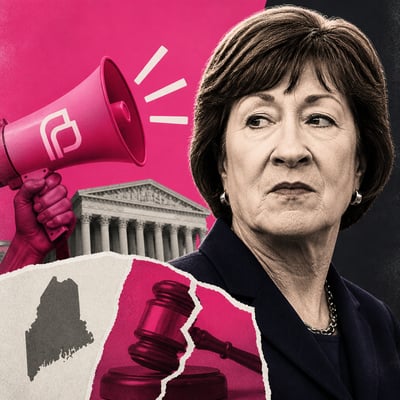
Democratic-aligned groups are directing substantial advertising and direct mail at Republican Sen.
Susan Collins in her 2026 contest with Democrat Troy Jackson, criticizing her 2018 vote to confirm Brett Kavanaugh. Collins says she supports abortion access and stands by that vote, while Jackson promotes his own record and reproductive-rights endorsements. The issue is a prominent campaign message, though the available reporting indicates that economic concerns rank higher for many voters.
If you read one thing
It connects Collins’s Kavanaugh vote and abortion messaging to the issue’s uncertain electoral salience and voters’ competing economic concerns.
The evidence
It documents the substantial advertising and mail campaigns making Collins’s judicial record a central campaign issue.
The evidence
It provides voter-level reporting on older women who cite Collins’s Kavanaugh vote and abortion rights as reasons for opposing her.
The counter-case
It presents the counterargument that the Kavanaugh attack may reinforce existing opposition more than persuade new voters.
Coordinated abortion-focused spending
Abortion-rights groups are using substantial advertising and targeted mail to make Collins’s judicial record a campaign issue. Reported efforts include Planned Parenthood Votes ads and a $250,000 mail campaign aimed at more than 100,000 Maine households.
Kavanaugh vote as a central liability
Jackson and allied groups connect Collins’s 2018 Kavanaugh confirmation vote to the later overturning of Roe, challenging her pro-choice identity. Collins stands by the vote and defends her broader abortion-access record, leaving the issue a contested campaign contrast.
Abortion’s electoral salience is constrained
Polling and voter reporting indicate that many Mainers oppose overturning Roe, yet few name abortion as their top voting issue; economic and household concerns rank higher. Campaigns see abortion as a potential mobilizing or persuasion issue, but its effect on the race remains uncertain.
$250,000 USD
direct-mail campaign spending
“Reproductive Freedom for All launched a $250,000 direct-mail campaign targeting women who support reproductive freedom.”
more than $600,000 USD
advertising spending
“Planned Parenthood’s advocacy arm is spending more than $600,000 on advertisements linking Collins to the end of abortion rights.”
all 16 counties
Maine counties represented in the Women for Troy coalition
“Since launching his campaign in July, Jackson has announced a “Women for Troy” coalition with members from all 16 Maine counties and won endorsements from Planned Parenthood and Reproductive Freedom for All.”
$23.5 million USD
Reproductive Freedom for All's My Body. My Ballot campaign
“The effort is part of Reproductive Freedom for All’s $23.5 million “My Body. My Ballot” campaign and comes as Collins faces Maine voters for the first time since the Supreme Court’s 2022 Dobbs v. Jackson Women’s Health Organization decision eliminated the federal constitutional right to abortion.”
at least $500,000 USD
Planned Parenthood Votes spending on ads
“Planned Parenthood Votes has spent at least $500,000 on ads, including one featuring a woman who regrets voting for Collins because of the Kavanaugh vote.”
Contested Issue
Will abortion-focused attacks on Susan Collins over her Kavanaugh vote materially expand opposition to her, or mainly reinforce voters who already oppose her?
Interviews with some older former Collins supporters and a Democratic pollster describe the Kavanaugh vote as a break in trust and a source of voter erosion. Political scientist Jim Melcher argues that the attack is more likely to reinforce existing opposition than generate substantial new opposition. The evidence supports a disagreement about the campaign message’s reach, not a claim that all voters respond alike.
Meaningful voter erosion
The Kavanaugh vote and abortion issue have weakened Collins among some former supporters, including older women, and may help move them toward Jackson.
Limited incremental effect
The Kavanaugh vote remains a useful attack in broadly pro-choice Maine, but is more likely to reinforce existing Collins opponents than create substantial new opposition.
New reporting reiterates the existing Kavanaugh-focused attack and the uncertainty over abortion’s electoral impact; it does not establish a material change in the contest.
Previously
Troy Jackson and allied abortion-rights groups are making Susan Collins’s 2018 vote to confirm Brett Kavanaugh a central campaign attack, linking it to the Supreme Court’s later decision to overturn Roe v. Wade. Planned Parenthood Votes and Reproductive Freedom for All have committed substantial advertising and direct-mail resources against Collins, while Collins maintains that she supports abortion access and does not regret the Kavanaugh vote. The fight gives Jackson a way to challenge Collins with abortion-rights voters while forcing the incumbent to defend a position that combines support for abortion access with support for key conservative judicial nominees.
The current version largely confirms the existing story, with slightly greater emphasis on Collins’s Kavanaugh vote and Jackson’s challenge among abortion-rights voters. No material new event, actor, or claim is introduced.
The attack has broadened from Collins’s Kavanaugh vote to include her Gorsuch confirmation, while reproductive-rights endorsements further align Jackson’s campaign with the issue.