
 AI Governance
 Data Centers
 Drones
 Climate
 Privacy
 Bob Dylan

AI Surveillance Expands Across Institutions
Coverage from C4ADS, CA Privacy Watch, and others
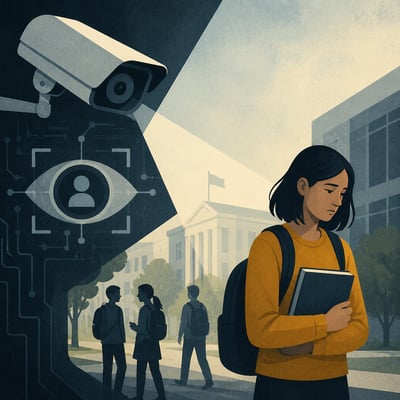
AI surveillance is expanding across educational institutions, campuses, workplaces, public spaces, and event security operations.
Systems can analyze faces, movement, behavior, online activity, and other signals to support security or educational functions, while also creating detailed profiles that may affect people without clear notice or meaningful control. The central privacy questions concern data accuracy, retention, vendor and government access, secondary use, and whether temporary or limited deployments become persistent infrastructure.
The story now places more emphasis on how AI surveillance can combine data, generate inferred traits or risk scores, and extend its use beyond the original purpose. It also adds a clearer governance concern around vendor and government access, later analytics, and model training.
The story now includes a concrete new implementation example: MIT’s large-scale camera rollout with defined retention, alongside a paused school robot-teacher pilot in New York. It also broadens from education/workplace surveillance to more explicit public-space and social-media monitoring, sharpening the privacy concerns around inferred data and contesting AI-generated conclusions.