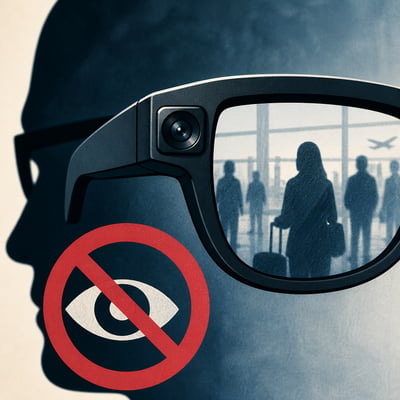
Meta Smart Glasses Privacy RisksMeta Smart Glasses Privacy RisksCoverage from WIRED, The Guardian, and others
00/00/0000
DailyWeekly
Meta's smart glasses are being pushed toward facial recognition and other always-on biometric features, while privacy scrutiny grows around covert recording, bystander consent, data labeling, and state-law compliance.
The current signal is dense and coherent, with Meta at the center and recurring concern about whether consumer eyewear is becoming a practical surveillance device.
Looking Back
529 Day Timeline
Articles published over time. Hover any bar for the period and its article count.
Feb '25
May '25
Jul '25
Oct '25
Jan '26
Apr '26
Jul '26
History
07/21/2026
The story has shifted from a pre-launch push to block facial recognition to evidence that Meta may already have developed NameTag and that its smart-glasses ecosystem can route media through Meta systems, bringing concrete biometric and data-handling risks to the foreground. It also now includes user backlash and partial product-side responses, while the legal frame has narrowed toward state biometric privacy law compliance.
07/21/2026
The story has shifted away from Google and Samsung’s upcoming AI glasses and now centers on a separate, more urgent Meta regulatory fight over facial recognition in smart glasses. The new emphasis is on preemptive government intervention to stop biometric surveillance before consumers can buy the feature.
Meta removed NameTag face-recognition code from the Meta AI app after reporting, renewing legal debate under Illinois and Texas biometric privacy laws.
7/15/2026 • Personal Data & Identity • Biometric Data (face
Meta paused the Model Capability Initiative workplace monitoring program in response to employee privacy concerns and reported internal access exposure while Meta investigates.
6/24/2026 • Data Collection & Surveillance Practices • Workplace Surveillance
Meta paused the Model Capability Initiative in 2024 after employee petitions and reported internal access concerns about laptop computer activity data used for AI training.
6/24/2026 • Data Collection & Surveillance Practices • Workplace Surveillance
Meta paused its Model Capability Initiative in response to employee privacy concerns after reporting exposure risks for laptop data used for AI training.
6/24/2026 • Data Collection & Surveillance Practices • Workplace Surveillance
Meta Ray-Ban Display Glasses create privacy risks by default media uploads and potential human review for AI training, affecting bystanders in public spaces.
3/10/2026 • Privacy Technology & AI • AI Training Data & Consent
EPIC urges the FTC and nine state regulators to block Meta from deploying facial recognition in Ray-Ban Meta glasses this year in the United States due to privacy risks.
2/13/2026 • Privacy Technology & AI • Facial Recognition Systems
WIRED reported June 2026 that Meta built an unreleased NameTag on-device facial recognition feature for smart glasses, generating biometric signatures before removing code after executive disagreement.
7/15/2026 • Personal Data & Identity • Biometric Data (face
Meta paused the Model Capability Initiative in the 2020s after U.S. employee tracking data exposed to the full workforce triggered a SEV2 security review.
6/23/2026 • Data Breaches & Exposure Events • Corporate Data Leaks
Meta paused an April workplace surveillance initiative for AI training after an internal incident exposed employee data to any employee inside the company.
6/25/2026 • Data Collection & Surveillance Practices • Workplace Surveillance
Meta faced a lawsuit in Oakland, California, filed by 26 former employees alleging internal AI systems used productivity monitoring to select workers for layoffs.
7/17/2026 • Data Collection & Surveillance Practices • Workplace Surveillance
Elle Hunt tests Meta Ray-Ban smartglasses for a month, reporting usability issues and privacy concerns about ambiguous public filming and always-on camera presence.
3/31/2026 • Data Collection & Surveillance Practices • Mobile App Data Collection
Meta updated the Model Capability Initiative workplace tracking software in response to employee privacy concerns, adding a 30 minute pause and exemption requests for work-device data capture.
6/4/2026 • Data Collection & Surveillance Practices • Workplace Surveillance
Meta employees in California and New York pushed back against mandatory laptop surveillance used to train AI agents, with UK unionization efforts increasing as rollout approaches.
5/18/2026 • Data Collection & Surveillance Practices • Workplace Surveillance
An investigation reported Ray-Ban Meta smart glasses sent intimate videos to Kenya-based contractors for AI training, with frequent face-blur failures and privacy risks.
7/20/2026 • Data Collection & Surveillance Practices • General
Meta disclosed an internal data breach exposing keystroke monitoring data used for AI training, allowing employees to access colleagues typing information.
6/22/2026 • Data Collection & Surveillance Practices • Workplace Surveillance
Meta workplace monitoring introduced in April, with the Model Capability Initiative, faced scrutiny after reports described internal exposure of collected data and a pending Department of Justice review.
6/23/2026 • Data Collection & Surveillance Practices • Workplace Surveillance
Mark Zuckerberg-linked leaked audio alleges Meta employee-monitoring software captures keystrokes and clicks, raising workplace privacy concerns as AI strategy expands.
5/20/2026 • Data Collection & Surveillance Practices • Workplace Surveillance
New York courts banned Ray-Ban Meta smart lenses to prevent filming of legal proceedings amid privacy and consent concerns over embedded cameras and tracking.
7/10/2026 • Data Collection & Surveillance Practices • Workplace Surveillance
Meta smart glasses may add facial recognition, raising privacy and safety concerns including covert filming risks and worsened exposure harms for sex workers.
Meta develops super sensing smart glasses with continuous audio and photo capture, proposing metadata-only processing while changing LED indicator controls to address recording notice concerns.
7/8/2026 • Privacy Technology & AI • Privacy Technology & AI: AI Training Data & Consent
Meta, announced an update in 2024 to disable the smart glasses camera when tampering with the privacy LED is detected, amid bans in New York State courtrooms and other venues.
7/7/2026 • Privacy Technology & AI • Facial Recognition Systems
Meta executives Andrew Bosworth and Andy Stone addressed Wired reporting on NameTag, an unreleased AI Glasses facial recognition feature, including local encrypted biometric faceprints.
7/18/2026 • Privacy Technology & AI • Facial Recognition Systems
Meta embedded NameTag facial recognition code into the Meta AI app for smart glasses, with EFF Threat Lab confirming a potential on-phone faceprint matching workflow.
6/5/2026 • Privacy Technology & AI • Facial Recognition Systems
Wired and Electronic Frontier Foundation reported dormant facial-recognition code in Meta smart glasses and a potential Rank One Computing biometric technology link in June.
6/16/2026 • Privacy Technology & AI • Facial Recognition Systems
Meta added dormant NameTag facial recognition code to the Meta AI app for Ray-Ban and Oakley smart glasses, while researchers warned about biometric identification risks.
6/5/2026 • Privacy Technology & AI • Facial Recognition Systems
Mark Zuckerberg outlined Meta plans for smart-glasses personal AI agents during Meta first-quarter earnings in 2020s, while privacy concerns cited third-party contractor access to sensitive data.
4/30/2026 • Privacy Technology & AI • AI Training Data & Consent
Google announced deeper Gemini Intelligence integration on upcoming Samsung Galaxy and Google Pixel phones, enabling AI autofill of forms using connected app data.
5/12/2026 • Privacy Technology & AI • Automated Decision Impacts
Google at Google I/O announced Gemini-powered Search updates including an intelligent search box, contextual Chrome-tab support, and agentic actions that may use connected account data.
5/19/2026 • Privacy Technology & AI • Algorithmic Profiling
Meta announced time limits for Meta Smart Glasses conversation focus, limiting free usage to three hours per month and offering a $20 per month tier with higher caps.
7/1/2026 • Privacy Technology & AI • Facial Recognition Systems
Meta faces a privacy lawsuit in the United States and an ICO probe in the United Kingdom in 2025 over smart glasses data collection and overseas footage review.
3/5/2026 • Data Collection & Surveillance Practices • General
Wired reported in 2024 that Meta embedded unactivated NameTag facial recognition code in an AI companion app for smart glasses, drawing privacy watchdog scrutiny.
6/5/2026 • Privacy Technology & AI • Facial Recognition Systems
Texas Attorney General Ken Paxton opened a consumer protection investigation into Meta AI Glasses, alleging continuous data capture, facial geometry risks, and privacy marketing issues in the 2020s.
5/20/2026 • Privacy Technology & AI • Facial Recognition Systems
EFF researchers and subsequent legal and investigative reporting link Meta Ray-Ban glasses to dormant facial recognition and disputed biometric training-data practices across multiple countries in 2025-2026.
6/28/2026 • Privacy Technology & AI • Facial Recognition Systems
Meta prototypes super-sensing smart glasses with continuous audio and frequent image capture, prompting privacy experts to warn about biometric law risk and U.S. wiretapping consent uncertainty.
7/9/2026 • Privacy Technology & AI • Privacy Technology & AI: AI Training Data & Consent
Meta executives issued conflicting statements about the NameTag facial recognition system, prompting privacy concerns as EU AI Act and U.S. lawmakers scrutinize Meta AI practices.
7/15/2026 • Privacy Technology & AI • Facial Recognition Systems
Google and Samsung unveiled Gemini-integrated Android XR smart glasses for a fall 2026 launch, but visual-input retention and AI-training disclosures remain unresolved.
5/20/2026 • Privacy Technology & AI • Privacy Technology & AI: AI Training Data & Consent
WIRED reported Meta embedded NameTag facial-recognition code in the Meta AI app for Ray-Ban Meta smart glasses, and Meta removed most traces within 24 hours.
6/9/2026 • Privacy Technology & AI • Facial Recognition Systems
Meta CTO Andrew Bosworth said Meta is considering facial identification for Meta AI glasses, focusing on encrypted recognition of known people rather than unknown individuals.
7/9/2026 • Privacy Technology & AI • Facial Recognition Systems
Meta tested Rank One Computing face recognition in smart glasses in 2026, then removed the feature on June 5 after reporting of dormant biometric integration.
6/15/2026 • Privacy Technology & AI • Facial Recognition Systems
Meta, after Wired reporting talks with Rank One, said no facial recognition face ID feature has shipped for AI glasses and any decision would follow a careful rollout plan.
6/15/2026 • Privacy Technology & AI • Facial Recognition Systems
WIRED reported dormant NameTag face-identification references in the Meta AI app for Ray-Ban Meta smart glasses, later removed in an update, raising consent concerns.
6/9/2026 • Privacy Technology & AI • Facial Recognition Systems
WIRED reported a secret licensing deal in which Meta licensed Rank One Computing facial recognition and liveness tools for smart glasses prototypes, then removed dormant code on June 5.
6/15/2026 • Privacy Technology & AI • Facial Recognition Systems
Meta roadmap leaked by geeky-gadgets describes 2026 smart-glasses and a facial recognition feature, raising consent and biometric data governance concerns.
6/8/2026 • Privacy Technology & AI • Facial Recognition Systems
Wired reported hidden NameTag facial-recognition code in Meta smart glasses, prompting Meta officials to deny consumer availability and critics to raise surveillance concerns.
6/15/2026 • Privacy Technology & AI • Facial Recognition Systems
Meta filed a July 2 patent for an AI wearable that records audio cues to infer emotional state and drive fitness coaching, prompting privacy criticism from Fairplay.
7/9/2026 • Privacy Technology & AI • Algorithmic Profiling
Meta removed unreleased NameTag facial-recognition code from Meta AI after reporting, while a class action alleges Meta Pixel collects sensitive healthcare data from U.S. hospitals and patient portals for advertising.
6/14/2026 • Privacy Technology & AI • Facial Recognition Systems
Ken Paxton opened a May 21, 2026 Texas investigation into Meta smart glasses over potential unlawful biometric capture and unauthorized bystander recording.
7/8/2026 • Privacy Technology & AI • Facial Recognition Systems
Meta removed most NameTag facial recognition code from the Meta AI app after reporting, as a class action alleges Meta Pixel collected sensitive healthcare data without consent.
6/14/2026 • Privacy Technology & AI • Facial Recognition Systems
US senators warned in a letter about Meta smart glasses facial recognition and potential surveillance risks amid reported US Border Patrol and ICE use.
3/18/2026 • Privacy Technology & AI • Facial Recognition Systems
A privacy-focused report warns that camera-equipped smart glasses can enable covert public recording, including an alleged London case, where limited regulation leaves social norms as safeguards.
7/8/2026 • Data Collection & Surveillance Practices • Data Collection & Surveillance Practices: Online Tracking & Ad Tech
US senators sought explanations from Meta in the 2020s over proposed facial recognition in smart glasses, warning about mass surveillance and insufficient user privacy controls.
3/18/2026 • Privacy Technology & AI • Biometric Data (face, fingerprints, DNA
Meta camera glasses raise privacy concerns by enabling ambient collection and cognitive inference from bystanders without consent, with chilling-effect risks discussed in 2026 reporting.
6/14/2026 • Data Collection & Surveillance Practices • General
In London, a UK activist group protested Meta camera glasses over reported super sensing features and demonstrated identification via facial-search and people-search tools.
7/18/2026 • Data Collection & Surveillance Practices • Data Collection & Surveillance Practices: Online Tracking & Ad Tech
Meta released tamper-aware firmware for smart glasses to disable recording on LED tampering as privacy concerns persisted across public recording, AI photo handling, and emerging facial recognition features.
7/8/2026 • Privacy Technology & AI • Facial Recognition Systems
U.S. Democratic senators sought answers from Meta over proposed facial recognition in Meta AI smart glasses, citing covert ambient identification risks and potential biometric-data misuse in public and immigration contexts.
3/18/2026 • Privacy Technology & AI • Facial Recognition Systems
Consumer Federation of America and UltraViolet Action and other groups asked U.S. Congress to block Meta facial recognition in smart glasses after Swedish reporting alleged sensitive video labeling by subcontractors in Kenya.
3/31/2026 • Privacy Technology & AI • Facial Recognition Systems
Meta launched Starfire Kylie smart glasses with facial-recognition and recording capabilities amid criticism about consent and surveillance-oriented data practices.
7/2/2026 • Data Collection & Surveillance Practices • General
Amy Odell discusses how Meta AI smart glasses, promoted through influencers and fashion, may normalize AI-enabled wearable surveillance in public life.
7/9/2026 • Data Collection & Surveillance Practices • General
Meta plans facial recognition for smart glasses, raising privacy and safety concerns for survivors in the United Kingdom, according to reports citing a New York Times story.
2/20/2026 • Privacy Technology & AI • Facial Recognition Systems
Meta plans to add facial recognition to smart glasses, potentially enabling continuous biometric data collection in the United States during a politically turbulent period.
2/13/2026 • Privacy Technology & AI • Facial Recognition Systems
Texas Attorney General Ken Paxton opened a May 20 investigation into Meta AI smart glasses over privacy risks involving audio, video, and facial data processing.
5/28/2026 • Regulation, Law & Enforcement • Regulatory Enforcement Actions
In the U.S., over 60 civil society organizations urged Meta and EssilorLuxottica in coordination with the FTC and DOJ over reported facial recognition plans for Ray-Ban smart glasses.
4/1/2026 • Privacy Technology & AI • Facial Recognition Systems
In the U.S., Senators Wyden and Merkley asked Meta in 2020s correspondence to explain facial recognition plans for Ray-Ban smart glasses amid privacy and surveillance concerns.
3/19/2026 • Privacy Technology & AI • Facial Recognition Systems
Meta workers protested after MCI workplace monitoring began in April, with cursor logging and screenshots raising U.S. labor-law and GDPR Article 88 concerns.
5/14/2026 • Data Collection & Surveillance Practices • Workplace Surveillance
Swedish newspapers report that Meta Ray-Ban glasses are reviewed by humans after user interactions in Nairobi, Kenya, prompting a class action over privacy.
3/5/2026 • Consumer Privacy & Digital Rights • Consent & Notice Practices
Senators Ed Markey, Ron Wyden, and Jeff Merkley asked Meta by April 6 to explain smart glasses facial recognition plans, citing biometric privacy and protest risks.
3/21/2026 • Privacy Technology & AI • Biometric Data (face, fingerprints, DNA
Manufacturers are producing fashion-forward AI smart glasses that capture biometric data, prompting legal and workplace privacy assessments in the United States in the 2020s.
1/1/1900 • Data Collection & Surveillance Practices • Biometric Data (face, fingerprints, DNA
In February 2025, Lei Technology describes how Meta's potential Name Tag facial recognition feature for U.S. smart glasses raises significant biometric privacy and surveillance concerns.
2/14/2025 • Privacy Technology & AI • Facial Recognition Systems
Meta plans to add Name Tag facial recognition to smart glasses as soon as 2026 in global markets including Australia, prompting regulator scrutiny and expert warnings.
1/1/1900 • Privacy Technology & AI • Biometric Data (face, fingerprints, DNA
Reports show men using Meta Ray-Ban smart glasses to secretly record women and children in public, while Meta explores facial recognition tied to Instagram accounts across the USA and Europe.
2/17/2026 • Data Collection & Surveillance Practices • Biometric Data (face, fingerprints, DNA
Ogletree Deakins / "Jennifer Monrose Moore, Brandon R. Sher, and Maja Veselinovic"0
Retailers managing smart glasses face privacy and employment-law constraints, especially around audio-video recording, facial recognition capture, and ADA accommodation processes.
3/28/2026 • Privacy Technology & AI • Facial Recognition Systems
Meta has explored integrating facial recognition into Ray-Ban smart glasses in 2020s discussions, prompting privacy and GDPR-related scrutiny in Europe and the United States.
2/16/2026 • Privacy Technology & AI • Facial Recognition Systems
Consumer Federation of America and Ultraviolet Action led a 64-organization coalition letter in the US urging Meta to abandon facial recognition integration for Meta glasses.
3/30/2026 • Privacy Technology & AI • Facial Recognition Systems
Meta is testing a facial-recognition feature for smart glasses with EssilorLuxottica in 2020s, raising biometric privacy and regulatory concerns in the USA and Europe.
2/16/2026 • Privacy Technology & AI • Facial Recognition Systems
In Washington, D.C., 64 civil society groups urged Congress, regulators, Meta, and EssilorLuxottica to oppose facial recognition features in Meta glasses.
3/30/2026 • Privacy Technology & AI • Facial Recognition Systems
Google plans 2026 Android XR smart glasses using Gemini AI, with partner designs and camera and microphone features that raise public privacy concerns.
Google and Samsung plan Gemini-powered smart glasses with face cameras and AI features, prompting privacy concerns about always-on sensing and processing.
5/19/2026 • Privacy Technology & AI • Privacy Technology & AI: AI Training Data & Consent
Google Labs launched Dreambeans, an AI media feed using Google Workspace, Photos, YouTube, and Search history, and generating selfie-based images for Ultra subscribers on iOS and Android.
7/1/2026 • Privacy Technology & AI • Privacy Technology & AI: AI Training Data & Consent
On May 19 in Ireland, committee officials pressed for smartglasses privacy and consent regulation after Cork reports of camera recording in workplaces and medical emergencies.
5/21/2026 • Regulation, Law & Enforcement • Law & Enforcement: Privacy Legislation
Meta’s MCI workplace monitoring program, aimed at training autonomous AI agents, is challenged under GDPR requirements by privacy experts and the Irish Data Protection Commission.
5/30/2026 • Regulation, Law & Enforcement • Law & Enforcement: Privacy Legislation
Meta facial recognition on AI smart glasses is reported via a leaked March 31, 2026 memo, after seven million-plus sales in 2025 raised biometric privacy concerns.
3/30/2026 • Privacy Technology & AI • Biometric Data (face, fingerprints, DNA
Meta collects video with Ray-Ban smart glasses and transmits it to external annotators for AI training in global deployments, currently raising privacy concerns about bystander consent.
Amanda Irons-Rindfleisch discusses wearable smart glasses privacy risks in public spaces, in the present, with Monroe County and Niagara County authorities.
3/4/2026 • Data Collection & Surveillance Practices • General
Meta plans timed launch of facial-recognition on smart glasses, prompting U.S. privacy concerns from civil liberties groups and demonstrations of misuse.
2/14/2026 • Privacy Technology & AI • Facial Recognition Systems
Texas Attorney General Ken Paxton opened a consumer protection investigation into Meta AI Glasses in 2020s-era scrutiny over always enabled recording and facial biometric data handling.
5/20/2026 • Regulation, Law & Enforcement • Regulatory Enforcement Actions
Wyden, Merkley, and Markey asked Meta for April 6, 2026 transparency answers on smart glasses facial recognition, including biometric deletion and opt-out handling.
3/18/2026 • Privacy Technology & AI • Facial Recognition Systems
Wyden and Merkley warned Meta in a public letter that Smart Glasses facial recognition could expand mass surveillance and chill lawful protest in the United States.
3/20/2026 • Privacy Technology & AI • Facial Recognition Systems
Meta and EssilorLuxottica's Ray-Ban smart glasses, launched in 2023, raise privacy concerns in the European Union and United States due to always on cameras and AI features.
3/8/2026 • Data Collection & Surveillance Practices • General
Smart glasses in the USA and EU raise privacy concerns because always-on audio and video capture can be difficult for bystanders to detect and enforce.
3/25/2026 • Data Collection & Tracking • Surveillance
California and Wisconsin court authorities restrict recording by AI glasses, with New York and Philadelphia adopting smart-glasses bans to reduce facial-recognition privacy risks.
Meta smart glasses and U.S. immigration enforcement plans expand real-time facial recognition in U.S. public spaces, while Illinois BIPA and EU AI Act phase in biometric limits.
5/27/2026 • Privacy Technology & AI • Facial Recognition Systems
Meta released June AI glasses with Muse Spark upgrades, while reported Hey Meta media capture and potential facial recognition features raise public privacy concerns.
6/29/2026 • Privacy Technology & AI • Privacy Technology & AI: AI Training Data & Consent
Meta Ray-Ban Gen 2 smart glasses add AI, translation, and facial recognition features while prompting concerns about recording notice and identity-related data use.
5/11/2026 • Privacy Technology & AI • Facial Recognition Systems
Teyana Taylor wearing Ray-Ban Meta smart glasses at the BET Awards triggered criticism about covert recording and facial-recognition re-identification risks in the United States.
7/1/2026 • Privacy Technology & AI • Facial Recognition Systems
Texas Attorney General Ken Paxton announced an investigation into Meta smart glasses after concerns about recording, facial geometry capture, and potential facial recognition features.
5/20/2026 • Regulation, Law & Enforcement • Regulatory Enforcement Actions
Ken Paxton announced a Texas investigation into Meta smart glasses, focusing on video, audio, and facial-geometry capture and alleged subcontractor access.
5/20/2026 • Regulation, Law & Enforcement • Regulatory Enforcement Actions
Following promotion by Teyana Taylor, Meta smart glasses drew criticism online for non-consensual filming and risks from facial recognition testing by Rank One.
7/1/2026 • Privacy Technology & AI • Facial Recognition Systems
Apple plans smart glasses sales in 2027 while privacy controls for camera-enabled wearables are highlighted amid facial recognition concerns involving Meta and EssilorLuxottica.
5/31/2026 • Privacy Technology & AI • Privacy Technology & AI: AI Training Data & Consent
Brady Snyder adjusts Meta smart-glasses settings while Swedish reporting alleges Nairobi contractors reviewed sensitive footage and the UK ICO calls for stronger user control.
5/23/2026 • Privacy Technology & AI • Privacy Technology & AI: AI Training Data & Consent
Solos launched a Privacy Kit for AirGo V2 smart glasses and a camera-free AirGo A6 amid public concerns about privacy harms from camera-equipped glasses.
U.S. Department of Homeland Security proposes funding smart glasses for immigration enforcement biometric recognition as privacy groups raise consent and access concerns.
5/5/2026 • Privacy Technology & AI • Facial Recognition Systems
Meta faced privacy backlash in the UK, Ireland, Kenya, and the USA over wearable AI glasses featuring recording workflows, possible real-time facial recognition, and contested disclosures.
4/7/2026 • Privacy Technology & AI • Biometric Data (face, fingerprints, DNA
EU regulators and researchers document privacy risks from smart glasses, citing doxxing demonstrations, cloud reviewer access, and weak face anonymization under GDPR and EU AI Act.
3/27/2026 • Privacy Technology & AI • Facial Recognition Systems
Nicolle Weeks argues Meta Kylie Jenner smart glasses normalize ambient surveillance by hiding sensors and weakening bystander notice under Canada’s PIPEDA and Quebec Law 25 gap.
7/7/2026 • Privacy Technology & AI • Facial Recognition Systems
Wired and EFF Threat Lab report Meta facial recognition code running on millions of always-on surveillance glasses, matching faces against stored biometric faceprints.
6/4/2026 • Privacy Technology & AI • Facial Recognition Systems
EFF Threat Lab and researchers found facial recognition code in Meta AI smart-glasses software, and Meta removed it in a June 5 update after public scrutiny.
6/8/2026 • Privacy Technology & AI • Facial Recognition Systems
Meta reportedly developed a facial recognition feature for Ray-Ban Meta smart glasses using biometric data on users' phones, while Meta stated no final consumer rollout decision exists.
6/16/2026 • Privacy Technology & AI • Facial Recognition Systems
Irish officials discussed May 19 smartglasses with cameras, citing non-consensual recording allegations and calling for tighter privacy rules in Ireland.
5/21/2026 • Regulation, Law & Enforcement • Law & Enforcement: Privacy Legislation
Privacy experts said Meta smart glasses facial recognition renews regulatory gaps after reporting described faceprints stored on the user phone and limited opt-in consent.
6/22/2026 • Regulation, Law & Enforcement • Law & Enforcement: Privacy Legislation

 AI Governance
 Data Centers
 Drones
 Climate
 Privacy
 2026 Maine Senate
 Bob Dylan