
 AI Governance
 Data Centers
 Drones
 Climate
 Privacy
 2026 Maine Senate
 Bob Dylan

Bringing It All Back Home’s Electric Turn
Coverage from GRAMMY.com, AOL, and others
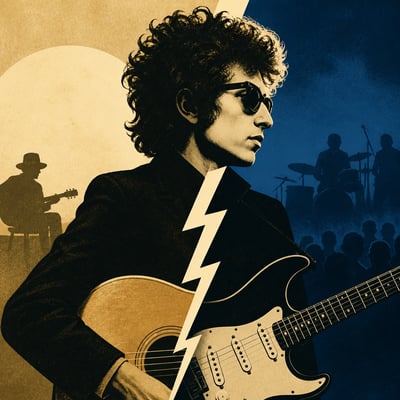
The topic centers on Bob Dylan’s Bringing It All Back Home, the 1965 album that paired electric rock instrumentation with acoustic songs and marked a decisive turn from his earlier folk presentation.
The album’s recording sessions, surreal and politically alert lyrics, and controversial reception—especially alongside Dylan’s later electric appearance at the Newport Folk Festival—remain central to accounts of his changing musical direction. Related material connects the album to Dylan’s Greenwich Village years, Another Side of Bob Dylan, Highway 61 Revisited, and later live performances of songs such as It’s Alright, Ma (I’m Only Bleeding).
If you read one thing
It provides the clearest overall introduction to the album's fusion of folk songwriting and electric rock.
The evidence
Its album-focused account directly illuminates the record's split acoustic-and-electric structure.
Best explainer
It explains how Dylan's electric turn accompanied a shift toward impressionistic, Beat-influenced lyrics.
The evidence
It places the album's transition within the broader rock transformation developed in Dylan's immediate subsequent work.
Electric-acoustic transition
Bringing It All Back Home is consistently positioned as a bridge between Dylan's folk-based work and electric rock, with its split acoustic/electric structure making the transition explicit. The album is treated as the formalization of a broader mid-1960s artistic pivot.
Expansion of lyrical subject and form
Coverage links the album's sonic change to a move away from established topical-protest conventions toward personal, surreal, symbolic, and Beat-influenced writing. This lyrical expansion is presented as a parallel transformation rather than a separate stylistic detail.
Watershed influence on rock
The album and its immediate follow-on works are treated as consequential beyond Dylan's catalogue: they broadened rock's lyrical and thematic range, helped establish folk-rock's possibilities, and connected studio experimentation with a contested live transition.
The new articles reinforce the established account of Dylan’s electric transformation through Highway 61 Revisited but add no material change to the topic’s understanding of Bringing It All Back Home.
Previously
This topic centers on Bob Dylan's 1965 transition from folk-based songwriting into electric rock, with Bringing It All Back Home as the key turning point. The material consistently frames the album, its singles, and the Newport electric set as connected steps in a rapid creative shift that changed how Dylan sounded and how his songs were received. It also shows the handoff from protest-oriented writing to more surreal, inward, and symbol-heavy lyrics.
The story is now framed more narrowly around Bringing It All Back Home itself rather than Dylan’s broader 1964–1965 transition. The update adds precise recording and album-structure details and extends discussion of the album’s later critical and live-performance reception.
The account remains substantively consistent, with only modest additions: Bob Johnston is newly named, and Newport’s divided response is described more explicitly as cheers and boos.
 Mitch Bogen's Art & Argument / Mitch Bogen