Dylan’s Newport Electric LegacyDylan’s Newport Electric LegacyCoverage from AOL, John Nogowski Substack, and others
00/00/0000
DailyWeekly
Recent books, films, restored footage, and performance releases are renewing attention to Bob Dylan’s 1964–66 shift from acoustic folk to electric rock.
Newport 1965 remains the anchor, while the 1966 tour, later archival sets, and selective current concert reporting broaden the picture toward arrangement, audience response, and catalog revision.
It places Newport within the longer musical transition that began at Philharmonic Hall and continued through Dylan’s electric-era recordings and touring.
Its close reading of documentary footage shows how restored visual evidence complicates the mythology by revealing both uneven arrangements and artistic confidence.
Untold Dylan / Tony Attwood
Key Issues
01
Newport remains the authenticity rupture
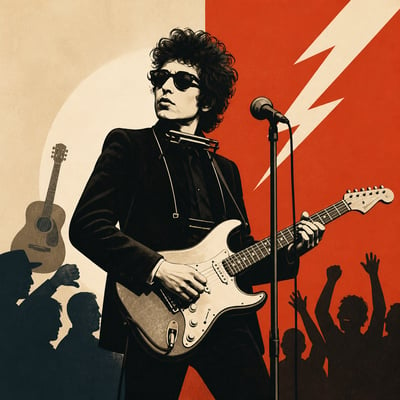
Dylan’s 1965 Newport electric set remains the central reference point for the break with acoustic folk expectations. The episode is chiefly understood as a conflict over authenticity that helped redirect folk toward electric rock and altered the relationship between artists and audiences.
Drawn from 5 articles
02
The shift is treated as a multi-stage transition
The electric turn is increasingly framed as a sequence running from the 1964 Philharmonic Hall concert through Bringing It All Back Home, Highway 61 Revisited, Blonde on Blonde, and the 1966 tour. This places Newport within a sustained process of catalog, arrangement, and live-performance reinvention rather than treating it as an isolated break.
Drawn from 6 articles
03
New media is expanding and revising the historical record
Restored Newport footage, documentaries, books, and retrospective reporting are sustaining attention while encouraging more contextualized reconstructions of the event. The resulting account tests simplified myths about the performance, its production circumstances, and the meaning later attached to it.
Drawn from 5 articles
04
Audience resistance remains part of the transition’s meaning
Accounts continue to emphasize the set’s improvised or uneven musical character alongside boos, heckling, confusion, and later tour fatigue. This friction is treated not merely as anecdote but as evidence of how Dylan’s new electric arrangements challenged established expectations before becoming a durable performance model.
Drawn from 5 articles
Looking Back
22319 Day Timeline
Articles published over time. Hover any bar for the period and its article count.
1965
1975
1985
1996
2006
2016
2026
The Story So Far
No material change
The supplied articles do not constitute new topic members since the prior state, so they provide no evidence of a material change in the underlying story.
Previously
Bob Dylan's electric appearance at the 1965 Newport Folk Festival dominates the material, with witness accounts, scholarship, and newly restored footage revisiting his break with acoustic folk expectations. The current retrospective cycle is being renewed by Newport & The Great Folk Dream, A Complete Unknown, and related archival and book projects. Album sequencing, the 1966 British tour, and later Newport appearances place the performance within a longer pattern of live and catalog reinvention.
History
08/26/2026
The story broadens modestly beyond Newport and the 1966 tour, incorporating the 1964 Philharmonic Hall concert and 1974 archival releases into a longer reassessment of Dylan’s live evolution. Recent accounts also sharpen the interpretation of the Newport set as brief, improvised, and under-rehearsed.
08/02/2026
The story has broadened from a general revisit of Dylan's Newport electric break to a more source-rich and historically specific reconstruction, driven by restored footage, documentary work, and scholarship that revises older simplifications. The current version also places the performance more firmly within the 1965–1966 studio-and-tour transition and emphasizes Dylan's continued engagement with folk material afterward.
On Jul 25, 1965, Bob Dylan performed an electric set at the Newport Folk Festival in Newport, provoking controversy that reshaped American folk and rock.
During concerts at Chicago's Arie Crown Theater, Bob Dylan gives a Panorama interview about electric music, folk roots, Newport reactions, and his personal outlook.
A 2024 critical essay examines how Bob Dylan's 1965 electric performances at Newport, Rhode Island, and during the British tour became a lasting cultural dispute.
In 1965, Bob Dylan advanced his electric-era songwriting on Highway 61 Revisited, including Like a Rolling Stone, amid Newport Folk Festival fan backlash.
Dylan electrified Newport Folk Festival on Sunday night in 1965 using an electric setup with the Paul Butterfield Blues Band, including Mike Bloomfield and Al Kooper.
Bob Dylan performed electric-era songs at the Newport Folk Festival in 1965 and returned in 2002, showing stylistic change alongside sustained folk tradition.
Busy Being Born (1960-66) describes Newport's jazz-to-folk festival split and Bob Dylan's 1963 Newport performances, foreshadowing later electrification conflict.
On July 25, 1965, at the Newport Folk Festival in Newport, Rhode Island, Bob Dylan performed an electric set that split the audience and accelerated folk-rock.
Bob Dylan's 1965 Newport Folk Festival performance is reexamined in light of Murray Lerner's documentary and the forthcoming biopic A Complete Unknown.
Bob Dylan's mid-1960s decision to tour with a full band is examined through interviews, contemporary reports, and tour records across the United States.
In a 2015 Substack article, the Peter Stone Brown Archives reviews Elijah Wald's Dylan Goes Electric!, focusing on Bob Dylan's 1965 Newport Folk Festival performance.
Recliner Notes publishes an article comparing Cat Power and Robyn Hitchcock's recordings that reinterpret Bob Dylan's 1966 Royal Albert Hall concert material.
12/3/2023 • Collaborations & Other Artists • General
In late July 1963, Bob Dylan's debut at the Newport Folk Festival in Freebody Park, Newport, Rhode Island, drew record audiences and critical attention.
Bob Dylan performed an electric set at the 1965 Newport Folk Festival in Newport, Rhode Island, with Johnny Cash publicly urging the folk community to withhold criticism before hearing Dylan.
George Wein recalls Bob Dylan’s controversial Newport electric performance and announces Folk Festival 50 will take place this August at Fort Adams State Park in Newport, Rhode Island.
Bob Dylan performed Hurricane, Oh, Sister and Simple Twist of Fate on Soundstage: The World of John Hammond, broadcast Dec 6, 1975 on Channel 13 in New York.
The author recounts seeing Bob Dylan play electric with Levon and the Hawks at Carnegie Hall on October 1, 1965, and links it to the Newport 1965 controversy.
Cult Following reviewed Bob Dylan's Providence 1975 Rolling Thunder Revue performance on 2025-11-30, focusing on the concert in Providence, Rhode Island.
WatchMojo highlights Bob Dylan's top ten moments spanning 1963 to 2020, including civil rights performances, the Newport electric breakthrough, and the Nobel Prize.
George Harrison defended Bob Dylan's 1965 shift from acoustic folk to electric rock after contentious performances at Newport, Royal Albert Hall, and Manchester.
Dylan's Subterranean Homesick Blues (March 1965) is credited with driving the electric-pop turn as it topped pop charts and fueled Newport Folk Festival controversy.
The Bob Dylan Center in Tulsa hosted a Going Electric tribute at Cain's Ballroom last summer to honor the 60th anniversary of Bob Dylan going electric.
1/4/2026 • Collaborations & Other Artists • General
Murray Lerner's documentary revisits Bob Dylan's 1963-1965 Newport Folk Festival performances in Rhode Island, documenting an uneven but historically significant electric transformation.
On July 25, 1965, Bob Dylan electrified the Newport Folk Festival in Newport, Rhode Island, splitting the audience with a short electric set before returning acoustically.
In July 1965, Bob Dylan performed electric material at the Newport Folk Festival in Newport, Rhode Island, sparking controversy and altering his career trajectory.
In 2025, Rolling Stone reported from the Newport Folk Festival in Newport, Rhode Island, detailing Dylan tributes and politically engaged performances by diverse artists.
Bob Dylan reflects on his 1960s shift to folk rock and the Newport Folk Festival electric moment in interviews with Bill Flanagan (2009) and the Wall Street Journal (late 2022) while naming influences from Son House to Eminem.
A Complete Unknown, directed by James Mangold and starring Timothée Chalamet as Bob Dylan, dramatizes Dylan’s 1960s rise and Newport electric set and earned eight Oscar nominations.
Bob Dylan briefly endorsed A Complete Unknown on X this month while the new Timothee Chalamet biopic and Elijah Wald's book examine Dylan's 1960s Newport electric controversy.
The New York Times reports on Dylan's 1965 Newport electric performance at Newport, Rhode Island, on July 25, 1965, and its portrayal in A Complete Unknown.
On July 25, 1965 at the Newport Folk Festival in Newport, Rhode Island, Bob Dylan performed an amplified set that provoked boos and changed the folk-rock landscape.
In August 1965 Bob Dylan recorded Highway 61 Revisited at Columbia Studios after a June session for Like a Rolling Stone and a Newport Folk Festival electric set.
Bob Dylan performed an electric set backed by Mike Bloomfield and members of the Paul Butterfield Blues Band at the Newport Folk Festival in 1965, provoking controversy and influencing popular music.
The article explains how Bob Dylan’s mid-1960s move to electric instruments sparked controversy, reflected broader 1960s trends, and influenced future musicians.
This week a Times of Israel essay compares Bob Dylan’s 1965 Newport electric set, Bruce Springsteen’s 1982 Nebraska album, and Abraham’s monotheistic break.

 AI Governance
 Data Centers
 Drones
 Climate
 Privacy
 2026 Maine Senate
 Bob Dylan
 Albums That Should Exist / Paul