
 AI Governance
 Data Centers
 Drones
 Climate
 Privacy
 2026 Maine Senate
 Bob Dylan
Police Drones Move Into 911 Response
Coverage from Twin Cities, Dronexl, and others
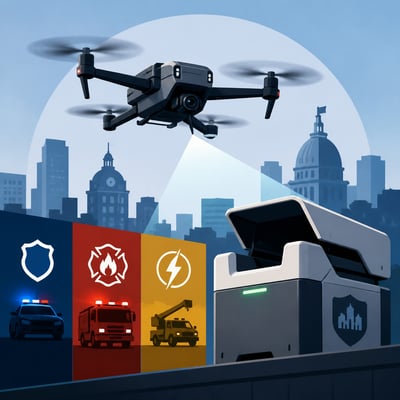
Police departments are expanding dock-based Drone as First Responder programs that launch from rooftops or fixed stations, stream live video to real-time crime centers, and support officers before they arrive at serious incidents.
Orlando, Fairfax County, Montgomery County, St. Petersburg, Colorado Springs, and agencies in Delaware County are scaling these systems for emergencies, searches, pursuits, crashes, and tactical calls. The growth is accompanied by investment in docks, trained pilots, dispatch integration, and centralized control, while San Francisco’s delayed policy vote shows that privacy, data retention, and permissible use remain unresolved in some jurisdictions.
If you read one thing
Orlando Police Launch 11-Drone Skydio DFR NetworkIt provides the clearest overview of how a multi-site docked drone network connects launches, dispatch, and live aerial response.
Best explainer
St. Petersburg Police Expand Drone Response ProgramIt shows how centralized control, live video, trained pilots, and expanding dock infrastructure turn DFR into an operational first-response system.
The evidence
San Francisco Delays Vote on Police Drone Privacy RulesIt grounds the expansion story in concrete privacy, retention, data-sharing, and surveillance-governance constraints.
Fixed-site DFR programs are scaling
Police agencies are moving docked Drone as First Responder systems into routine, multi-site operations, with expanding fleets, additional docks, trained operators, and rising flight volumes. Deployments now span emergency calls, searches, tactical incidents, and broader public-safety missions.
Drones are becoming dispatch-integrated first responders
911 systems, real-time crime centers, and centralized operations teams are increasingly used to launch, control, and distribute live drone video to officers and command staff. The core operational value is rapid pre-arrival awareness for threat assessment, searches, pursuits, and tactical response.
Privacy, governance, and security remain limiting conditions
Expansion remains contested over permissible surveillance, warrants, retention, data sharing, public oversight, and protections for uninvolved people. San Francisco’s delayed rules, St. Paul opposition, and exposed police drone feeds show that governance and operational security remain material constraints alongside deployment growth.
up to $200,000 USD
federal grant for additional police drones
“Two St. Paul City Council members said they oppose expanding the police department’s drone program. The council plans to vote next week on whether to approve the department’s application for a federal grant of up to $200,000 for additional drones.”
1,500 flights
flights since the docked program began
“Deputy Chief Kurt Hallstrom said each drone can fly for 20 minutes within a two-mile radius. He said the department has recorded 1,500 flights since the docked program began, compared with 346 drone uses during the previous year.”
20 minutes
flight duration per drone
“Deputy Chief Kurt Hallstrom said each drone can fly for 20 minutes within a two-mile radius. He said the department has recorded 1,500 flights since the docked program began, compared with 346 drone uses during the previous year.”
346 uses
drone uses during the previous year
“Deputy Chief Kurt Hallstrom said each drone can fly for 20 minutes within a two-mile radius. He said the department has recorded 1,500 flights since the docked program began, compared with 346 drone uses during the previous year.”
two-mile radius miles
operational radius per drone
“Deputy Chief Kurt Hallstrom said each drone can fly for 20 minutes within a two-mile radius. He said the department has recorded 1,500 flights since the docked program began, compared with 346 drone uses during the previous year.”
No material change is supported since the previous state because none of the supplied articles are new Topic members.
Previously
Police departments in Florida, Maryland, Virginia, Colorado, Pennsylvania, and California are expanding docked Drone as First Responder programs that launch from rooftop stations or other fixed sites after selected 911 calls. Operators stream live video to real-time crime centers and responding officers, helping agencies assess threats, locate people, support searches, and improve pre-arrival awareness. The deployments show growing investment in automated or remotely piloted response, while privacy rules, data retention, security, training, and the limits of surveillance remain important constraints.
The story now includes a concrete policy delay in San Francisco, underscoring that governance is lagging behind operational expansion. The programs are also being framed more clearly as centrally coordinated systems supporting a broader range of missions.
The story has shifted from a handful of deployments and an SFPD privacy failure toward broader, active scaling of Drone as First Responder networks across several states. New reporting also shows deeper integration with dispatch and real-time crime-center systems, plus rapid-response performance claims and expanding operational uses.