Data Centers Push PJM Toward Emergency…Data Centers Push PJM Toward Emergency MeasuresCoverage from Scranton Times-Tribune, Cincinnati Enquirer, and others
00/00/0000
DailyWeekly
Rapid data center growth is adding pressure to the PJM power system, with extreme heat exposing limited reserves, transmission constraints, and sharp wholesale price increases.
In response, the U.S. Department of Energy has repeatedly authorized PJM to direct large customers to use backup generation during emergencies, while PJM and utilities prepare for further demand growth. The response is also intensifying disputes over transmission costs, customer tariffs, emissions, and the extent to which data centers should provide or fund their own power capacity.
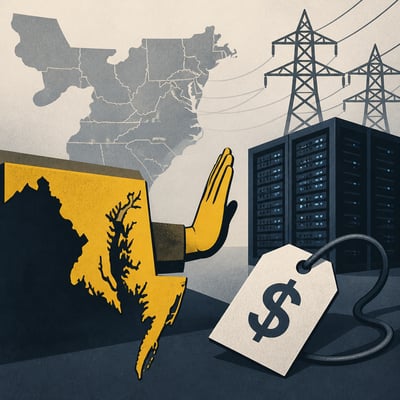
It presents the ratepayer-protection case against shifting uncertain data-center procurement costs onto existing customers.
Maryland Office of People's Counsel
65
Key Issues
01
PJM capacity is tightening while costs rise
Data-center demand continues to outpace near-term resource additions: PJM's latest capacity auction reached its price cap while remaining about 6.8 GW below its reliability target. Data centers are driving a substantial share of capacity and wholesale-cost exposure for other customers.
Drawn from 6 articles
02
Backup generation is a short-term reliability tool
Federal emergency authorizations allow PJM to direct data centers and other large loads toward onsite generation or curtailment during severe heat and reserve stress. The tool provides rapid flexibility but remains constrained by emissions, health, noise, and operating concerns; reported events generally did not require forced data-center disconnection.
Drawn from 6 articles
03
Data-center load behavior is becoming a reliability variable
The Ashburn disturbance demonstrated that hyperscale facilities can shed more than 3 GW and transfer to backup power within seconds, producing measurable grid imbalance even without a reported reliability impact. Operators and regulators are moving toward better telemetry, modeling, recovery requirements, and enforceable computational-load standards.
Drawn from 4 articles
04
Regulators are shifting obligations toward large-load developers
Pennsylvania is assigning more forecasting, curtailment, reporting, interconnection, and potential reliability-procurement obligations to large data centers, while Ohio proposals similarly emphasize self-supplied generation and developer-funded grid connections. Consumer advocates and other stakeholders continue to contest whether PJM-wide costs should instead be borne by existing customers.
Strengthening
Drawn from 6 articles
Key Numbers
four substations
new substations needed to connect the campus
new high-voltage connection infrastructure
“The project also says it will pay the full $4.2 billion cost of the new high-voltage transmission lines and four substations needed to connect the campus to the regional system.”
Cincinnati Enquirer
six months
maximum period for utilities to complete interconnection studies
“The tariff is intended to help utilities account for how large-load customers affect consumer costs, infrastructure and reliability. It makes large customers responsible for infrastructure and connection costs, requires financial deposits and collateral, and requires utilities to complete interconnection studies within six months.”
Altoona Mirror
$10 to $20 dollars per month
potential increase in some Ohio household electric bills
some Ohio households
“Data center demand may already be adding $10 to $20 a month to some Ohio household electric bills, yet utilities and regulators cannot tell customers exactly how much or why.”
Cincinnati Enquirer
10 gigawatts
planned new generation
PORTS-Pike campus
“It is expected to provide roughly eight gigawatts of computing power and plans approximately 10 gigawatts of new generation—enough, if used by homes instead, to serve about 8 million households.”
Cincinnati Enquirer
$4.2 billion USD
cost of new high-voltage transmission lines and four substations
project says it will pay the full cost
“The project also says it will pay the full $4.2 billion cost of the new high-voltage transmission lines and four substations needed to connect the campus to the regional system.”
Cincinnati Enquirer
Contested Issue
1 open dispute
Should data centers directly bear the incremental capacity, transmission, and interconnection costs associated with their electricity demand?
State regulators, utilities, and industry advocates are pursuing tariffs and procurement mechanisms that assign infrastructure and reliability costs to large-load customers, while consumer advocates argue that PJM backstop and transmission plans could shift uncertain or excessive costs onto existing residential and industrial ratepayers.
Large-load cost responsibility
3 articles · across 3 publications
Data centers and other new large loads should pay for the generation, capacity procurement, transmission, and interconnection upgrades they cause or require.
Ratepayer-protection concerns
3 articles · across 3 publications
PJM-wide or long-term backstop and transmission procurement should not place uncertain data-center-driven costs on existing residential and industrial customers; such plans should be rejected, narrowed, or made contingent on customer commitments.
Looking Back
121 Day Timeline
Articles published over time. Hover any bar for the period and its article count.
May 7
May 28
Jun 15
Jul 6
Jul 27
Aug 14
Sep 4
The Story So Far
Broadening
State rules expand data-center accountability to costs, curtailment, and self-supply
Pennsylvania is formalizing large-load obligations through customer-funded infrastructure, demand forecasting, potential priority curtailment, usage reporting, and possible charges for PJM backstop capacity. In Ohio, the PORTS-Pike proposal illustrates a self-supply model in which a hyperscale campus would develop roughly 10 gigawatts of generation and fund $4.2 billion in grid connections, while potential household cost impacts remain disputed.
Previously
Rapid data-center expansion is tightening PJM's capacity and transmission margins, exposing new reliability risks during heat, raising power costs, and pushing utilities and regulators toward emergency flexibility and developer-funded infrastructure.
History
09/08/2026
The response has moved from proposed emergency flexibility toward repeated federal authorizations allowing PJM to direct qualifying data centers onto onsite generation. Disputes over cost allocation and tariffs have also become more concrete, with named Maryland and Ohio stakeholders challenging who pays for grid upgrades.
08/29/2026
The story has shifted from projected data-center pressure and regulatory disputes to demonstrated operational stress, including a major Ashburn load-transfer incident and a capacity-auction shortfall. Regulators and utilities are also moving from debate toward assigning more grid-upgrade obligations directly to large-load customers.
DOE authorized PJM during a heat wave to require data centers across multiple states, including Pennsylvania, to use backup generators with permitting waivers for reliability.
Ohio utilities and regulators are evaluating how expanding data centers, including PORTS-Pike in Pike County and an Amazon Web Services proposal near Trenton, could affect electricity costs and grid infrastructure.
Monitoring Analytics asked FERC to require Mara Holdings to keep Long Ridge generation in PJM markets if the agency approves the proposed $1.5 billion sale tied to growing data center load.
DOE issued an emergency Federal Power Act section 202(c) order for PJM Interconnection to curtail backup-equipped large loads for three hot-weather days starting May 18 in Maryland and Virginia.
The US Department of Energy authorized PJM Interconnection on July 14, 2026, to direct eligible backup resources at large-load sites during Level 3 emergencies in the PJM region.
Monitoring Analytics and PJM reported data-center-driven demand raising PJM capacity charges in the June 2028 to May 2029 auction while PJM sought backstop procurement for reliability shortfalls.
PJM released annual auction results on June 30, projecting $6.3 billion in added electricity costs over three years driven by data-center peak power demand across 13 Eastern states and DC.
On July 2, PJM Interconnection issued emergency alerts during a heat wave but did not order power cuts to data centers in Northern Virginia, avoiding planned generator-based contingency.
DOE approved PJM Interconnection emergency authority from July 1 to July 3 to direct data centers and other large users to backup generators during record heat-driven demand in Ohio.
DOE issued Emergency Order No. 202-26-23 on May 18, 2026, enabling PJM to direct data-center backup generation during Level 3 alerts in the PJM region.
PJM Interconnection said grid strain from data center demand and delayed generation additions requires market design changes that may curtail power to new large-load customers during peaks.
Maryland’s Office of People’s Counsel filed a FERC complaint against PJM Interconnection over transmission cost allocation tied to projected data center load growth.
PJM and regional utilities reported record July peak demand during extreme heat, while demand-response and backup-generation arrangements were cited as limiting brownout risk.
PJM issued emergency load management and maximum generation alerts during extreme East Coast heat, while DOE authorized PJM backup generation at data centers.
PJM issued emergency demand-response orders during a heat wave to prevent outages as transmission congestion and generator outages reduced reserve margins in the Mid-Atlantic and Midwest.
Joseph Bowring of Monitoring Analytics reported data centers caused 38% of PJM Interconnection's latest capacity auction charges and urged a FERC-filed September backstop auction.
PJM and Dominion Energy managed a sudden 3,000-megawatt data-center disconnection after an Ashburn transmission fault, while PJM and NERC develop reliability standards.
Maryland's Office of People's Counsel and allied state advocates asked FERC in August to reject PJM's proposed 7,000-megawatt Reliability Backstop Procurement for data center demand.
PJM, SPP, and ERCOT experienced record or near-record July demand during extreme heat, with data center growth intensifying grid planning pressures across the United States.
The Energy Department has authorized PJM Interconnection and Southwest Power Pool since May to direct data centers and other large users onto backup generation during regional heat emergencies.
PJM reported a reliability imbalance after a Northern Virginia transmission line fault caused about 3 GW of data center load to drop between 7:55 and 8:00 a.m.
Dominion Energy and PJM reported that an Ashburn, Virginia transmission fault triggered more than 3 GW of hyperscale data center load to disconnect and transfer to backup power within seconds.
Monitoring Analytics quantified data centers as a major driver of PJM capacity charges while PJM missed reliability targets despite maximum-price capacity auctions.
PJM Interconnection reported a 6.8-gigawatt capacity shortfall in its latest auction for the second year, prompting Ohio lawmakers to advance bills addressing data-center driven electricity costs and forecast scrutiny.
DOE approved a PJM Interconnection request to potentially require Virginia data centers to run backup diesel generators during extreme-heat demand peaks.
PJM's independent market monitor reported on August 24 that data center load contributed materially to higher wholesale prices and capacity revenues during the first seven months of 2026.
PJM Interconnection reported a 2028/2029 capacity auction shortfall and plans a September FERC backstop procurement as Virginia data center load grows.
PJM stakeholders approved a reliability backstop procurement plan for a near-term capacity shortfall, targeting FERC review and a September auction to support data-center load growth.
PJM Interconnection and the Trump administration authorized emergency measures during an extreme heatwave, requiring data centers to activate backup generation through July 3.
PJM Interconnection forecasts record peak electricity demand during a heat wave as data-center growth increases congestion and reserve costs, while QTS withdraws a Virginia project filing.
FERC plans a July 23 technical conference with PJM to resolve tariff and jurisdiction responsibilities for data center load growth under the Federal Power Act.
PJM Interconnection reported a 2028-2029 capacity auction clearing at the 325 per MW-day cap as data centers increased forecast demand and reserve adequacy shortfalls persisted.
Eighty Maryland state lawmakers backed a May 7 FERC complaint arguing PJM transmission cost allocation for data-center-serving projects shifts costs to Maryland ratepayers, with comments due July 27.
PJM advanced a backstop reliability auction from March to September and urged member states to define auction cost allocation for new data center loads.
Pennsylvania regulators and PJM Interconnection moved in 2025 to shift power, grid-upgrade, and reliability risks for large AI data centers toward developers statewide.
Maryland Office of People’s Counsel, joined by consumer advocates from Ohio, Delaware, and Illinois, sought FERC clarification in 2026 on PJM data-center transmission cost allocation.
PJM Interconnection expects Thursday demand of about 166,147 MW and gained emergency authority to curtail data center and backup-generator load if needed.
Ohio Manufacturers Association told PUCO of Ohio that AES Ohio data center tariff terms could leave other customers exposed to transmission upgrade costs.
On May 27 and May 13, 2026, Pennsylvania issued GRID standards and a PUC model tariff for large-load data centers while PJM reported capacity-market scarcity pressures.
Monitoring Analytics warned PJM Interconnection that data center load is driving higher wholesale and capacity costs ahead of the June 2026 base residual auction.
Maryland People''s Counsel David Lapp urged PJM in Baltimore to exclude projected data center load growth from markets and transmission planning after an OPC filing at FERC challenged Maryland transmission cost assignment rules.
Maryland governor Wes Moore pushed PJM Interconnection reforms on May 11, proposing long-term contracts and added data-center cost responsibility as capacity prices surged.
PJM reported that a July 22, 2026 transmission disturbance in Northern Virginia caused data centers to transfer more than 3 GW to backup power within minutes.
During a heat dome, the U.S. Department of Energy issued a 2026 emergency order enabling PJM to direct large data centers toward onsite backup generators to protect grid capacity.
U.S. Energy Department authorized PJM to require data centers to use onsite backup power during an extreme heat wave across 13 states and Washington, D.C.
Ohio data center expansion is increasing electricity demand across PJM Interconnection, prompting curtailment actions and consideration of temporary hyperscale disconnections during peak conditions.
PJM Interconnection faced record power demand during July 2 heat, as AI data center load intensified grid reliability stress across multiple US RTO regions.
PJM Interconnection received a U.S. Department of Energy emergency order on an ongoing heatwave to require backup generators through July 3, affecting AI data centers.
PJM Interconnection requested U.S. Department of Energy emergency authority to require data centers to use backup generators during a Maryland heat wave through Friday.
PJM Interconnection proposed requiring data centers across its territory from Washington, D.C., to Chicago to use backup generation during future grid emergencies.
PJM Interconnection reported near-capacity-auction record pricing around $325 per megawatt-day in a reliability-shortfall year driven by rising data-center power demand.
PJM proposed Monday a large-load registry for data centers and other facilities across its 13-state region to prioritize electricity reductions during shortages.
Dominion Energy and PJM reported a transmission line outage in northern Virginia caused over 3 GW of data center load to drop offline on Wednesday, with backup power transfer and voltage disturbances extending to Chicago.
Senator Mark Warner backed the Power for the People Act in response to Virginia electricity price impacts from data-center growth tied to PJM reliability and utility cost allocation.
Monitoring Analytics reported sharp PJM wholesale price and capacity cost increases in the first quarter, citing AI data center load that tightens supply and stresses planning.
PJM Interconnection requested DOE action during a US heatwave after lawmakers and communities raised concerns about AI data center power and water strain.
Eighty bipartisan Maryland lawmakers urged FERC to limit transmission cost pass-through tied to out-of-state data center demand, citing projected $2 billion in higher Maryland bills.
Maryland enacted the Utility RELIEF Act in 2026, requiring data centers to register with the Public Service Commission and pay for grid connection upgrades.
Maryland candidates linked higher residential electric bills to data center load growth and supported the Utility RELIEF Act signed in May, with costs and grid upgrades targeted to developers.
Buckeye Power and Ohio's Electric Cooperatives developed a data-center load and cost-allocation process in Ohio to prevent existing members from bearing new grid and power costs.
Pennsylvania Governor Josh Shapiro directed the Public Utility Commission in Pennsylvania to develop data-center curtailment, forecasting, reporting, and cost-allocation rules as PJM faces projected capacity shortages.
PJM projected $6.3 billion higher power costs for 13 eastern states and D.C. over three years, citing data centers as the primary peak-demand driver amid New Yorks hyperscale moratorium.
Maryland primary candidates in 2026 surveyed by the University of Maryland-backed Local News Network largely backed tighter regulations on data center development amid rising residential electricity bills.
PJM asked the U.S. Department of Energy for an emergency reliability order that, during extreme heat, allows PJM to require data centers to switch to backup generators.

 AI Governance
 Data Centers
 Drones
 Climate
 Privacy
 2026 Maine Senate
 Bob Dylan