
 AI Governance
 Data Centers
 Drones
 Climate
 Privacy
 2026 Maine Senate
 Bob Dylan
Utilities Race to Power AI Data Centers
Coverage from American Chemical Society, Sunrun, and others
U.
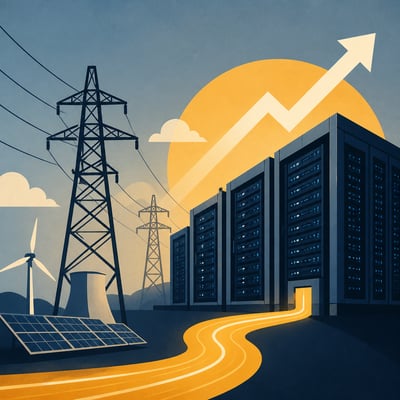
S. utilities and technology companies are committing substantial capital to meet fast-growing data center electricity demand, particularly in regions including Indiana, Ohio, Oklahoma, Texas, Michigan, Virginia, and Minnesota. AEP has raised its five-year capital plan to $78 billion, while other projects use batteries, solar, fuel cells, gas generation, and aggregated home devices to shorten power timelines when grid connections are delayed. These efforts could accelerate new energy investment and improve grid flexibility, but they also raise questions about emissions, customer costs, regulatory approval, project execution, and whether projected AI demand will materialize.
The story now has a more concrete geographic and operational shape, with added detail on where the demand surge is concentrated and how flexible-load proposals could be deployed in practice. The emphasis has also shifted slightly toward execution hurdles and AI-demand uncertainty, while the carbon-capture discussion is framed more specifically around infrastructure requirements.
The story now adds a much more concrete scale-and-timeline picture: interconnection delays are framed as potentially stretching to 12 years, and the proposed flexible-load and utility responses are presented with specific deployment and investment figures. It also sharpens the uncertainty around execution, emphasizing regulatory approval, customer enrollment, and whether AI-driven demand proves durable.